

cardio calculator2026-10-05T16:17:30+01:00

CARDIO ZONE CALCULATOR

Heart Rate Zone Calculator

Calculate your heart rate zones. Build smarter endurance. Train with more precision. 

Use the Karvonen heart rate reserve method to calculate your training zones, with an optional MAF aerobic base target to help you build a stronger, more resilient aerobic engine.

Trusted formula used by endurance athletes and coaches worldwide.

Build Your Cardio Training Zones

Enter your details below to calculate your heart-rate training zones using the Karvonen Heart Rate Reserve method, with an optional MAF aerobic-base target.

Train Smarter.
Go Further.
years
Used for estimated max HR and MAF.
bpm
Your average resting heart rate.
bpm
Tanaka estimate: 208 − (0.7 × age)
Training Method
Add a separate MAF aerobic-base estimate if desired.
Applies a modifier to the 180 − age estimate.
Provides activity-specific usage guidance.
Display
Switch between BPM and HRR percentages.
Calculate
Updates all training-zone results.

Your Cardio Training Zones

Karvonen Heart Rate Reserve + optional MAF aerobic target.
Resting Heart Rate
60 bpm
Your entered resting HR
Maximum Heart Rate
183 bpm
Your maximum HR
Heart Rate Reserve
123 bpm
Max HR − resting HR
MAF Aerobic Ceiling
145 bpm
180 − age + adjustment

Karvonen Training Zones (Heart Rate Reserve)

Zones calculated from HRR
Zone 1
Recovery
122–134 bpm
50–60% HRR
Very easy effort. Supports recovery, aerobic foundation and low-intensity conditioning.
Zone 2
Aerobic Base
134–146 bpm
60–70% HRR
Easy, sustainable effort. Develops aerobic endurance and supports long mountain sessions.
Zone 3
Tempo
146–158 bpm
70–80% HRR
Moderate, controlled effort. Builds aerobic capacity and the ability to sustain stronger work.
Zone 4
Threshold
158–171 bpm
80–90% HRR
Hard effort. Useful for threshold development and sustained high-intensity work.
Zone 5
VO₂ Max
171–183 bpm
90–100% HRR
Very hard effort. Develops maximal aerobic power, high-end conditioning and speed.

Aerobic Base Target — MAF 180

Separate estimate — not an additional Karvonen zone
MAF Aerobic Ceiling
145 bpm
180 − age, adjusted for selected training status
Suggested MAF Range
135–145
Approximately 10 bpm below the calculated ceiling
How your MAF range compares with your Karvonen zones
MAF range
Z1 Z2 Z3 Z4 Z5
122 134 146 158 171 183
Running / hiking: Use heart rate alongside perceived effort, terrain and pace. Uphill gradients can raise heart rate substantially even when speed is low.

How The Cardio Zone Calculator Works

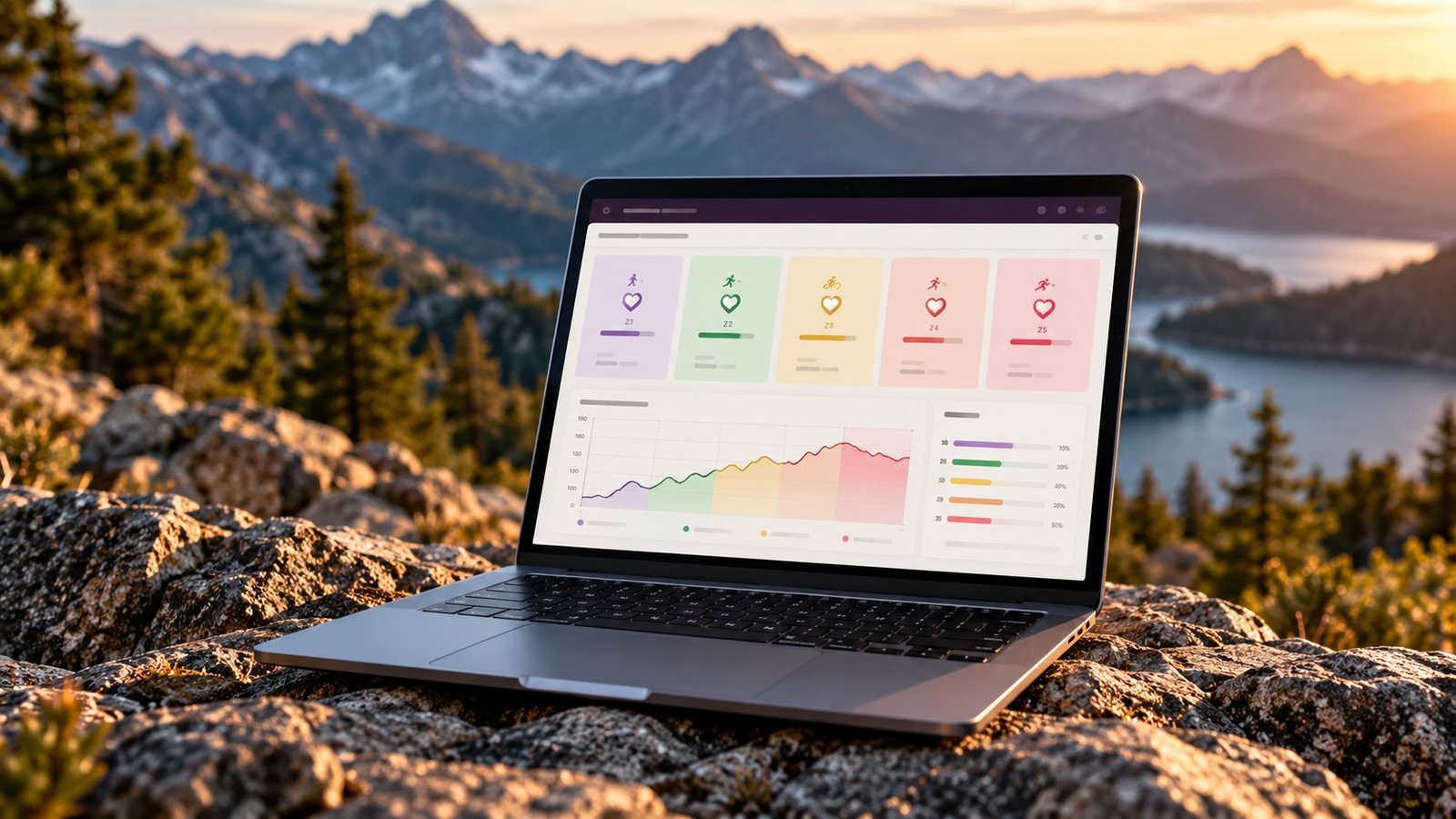
Our calculator uses the Karvonen method, with an optional MAF target, to create personalised heart rate training zones based on your details. It’s simple, accurate and designed to help you train with purpose for endurance and mountain performance.

STEP 1

Enter Your Details

Add your age, resting heart rate and maximum heart rate (or let us estimate it).
STEP 2

Calculate Your Zones

We use the Karvonen method to create your heart rate training zones, with an optional MAF target.

STEP 3

Apply to Your Training

Use your zones to guide your training, build endurance and perform stronger in the mountains.

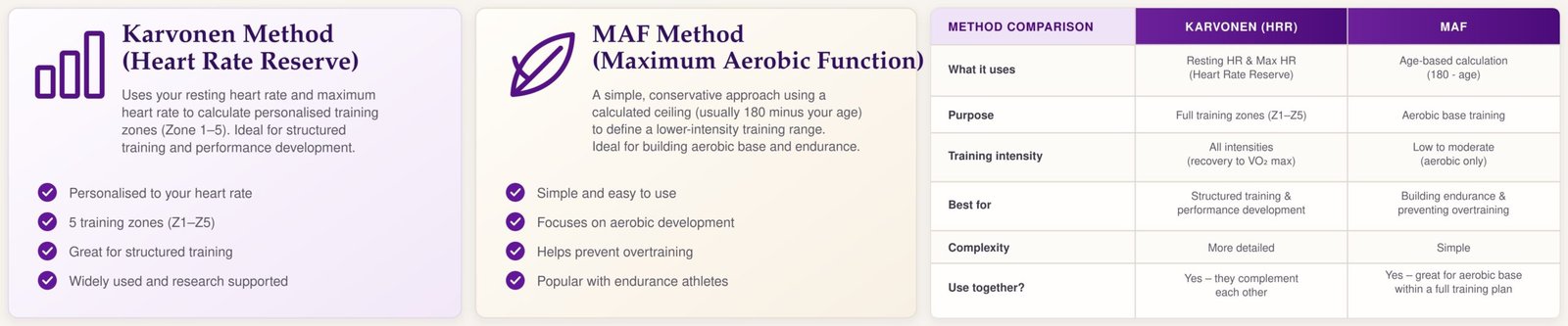
Karvonen vs MAF: What Is The Difference?

Both methods are valuable. They serve different purposes and can work well together.
How to Use Each Zone

Each heart rate zone has a different purpose. Use your zones to guide intensity, build fitness progressively and get the most from your training.

GO FURTHER WITH CONFIDENCE

When To Use Each Method

Different methods suit different goals. Here’s how to think about it.

Easy aerobic training

Use MAF to keep your effort conversational and build your aerobic base.

Endurance / Mountain days

MAF is ideal for long, steady efforts and building the aerobic foundation for big days in the hills.

Tempo / Threshold work

Use Karvonen zones (z3 – z4) for structured, higher intensity training and performance gains.

Mixed conditioning

Combine both methods — MAF for your easy days and Karvonen for your quality sessions.

Who Is The Calculator For?

The cardio training zone calculator is useful for anyone who wants to train smarter, build endurance and perform better in the mountains.


Trail Runners

Build aerobic fitness, run stronger for longer and handle technical terrain with more confidence.

Cyclists

Improve endurance, climb stronger and train with greater precision on long rides and mountain routes.

Hikers & Hill Walkers

Develop stamina for big days, manage effort on longer ascents and enjoy the mountains for longer with less fatigue.

Mountain Athletes / Ruckers

Build real-world endurance for mountain challenges, multi-day events and load carrying with sustainable, intelligent training.

Common Factors That Affect Heart Rate Zones

Your heart rate isn’t fixed. Several factors can influence it from day to day, so use your zones as a guide and listen to your body.

Stress & Fatigue

Mental and physical stress can increase heart rate, even at lower intensities.

Heat & Altitude

Hot conditions and higher altitudes can raise heart rate at the same effort.

Hydration

Dehydration can increase heart rate and reduce performance.

Caffeine

Caffeine can elevate heart rate, especially during the first few hours.

Fitness Changes

As you get fitter, your heart rate at a given effort will generally decrease.

Measurement Accuracy

Wrist based devices are very good, but can vary. For best accuracy use a chest strap.

Practical Heart Rate Training Notes

Get the most from your training zones with these key principles.

Use trends, not single sessions

Look at your heart rate over time. A single workout can be influenced by heat, sleep, stress or terrain. Focus on the bigger picture.

Retest as fitness changes

Your heart rate zones can shift as you get fitter. Revisit the calculator every few months to keep your training zones accurate.

Easy days should stay easy

Most of your training should be in the easy aerobic range. This builds endurance, improves recovery and prepares you for harder days.

Terrain changes effort

Uphills, technical terrain and altitude all increase heart rate. A higher heart rate on hills is normal — focus on effort, not exact numbers.

Pair HR with perceived effort

Heart rate is a powerful tool, but it works best alongside how you feel. Use both HR and perceived effort (RPE) to guide your training.

Why Heart Rate Training Matters For Mountain Athletes

Heart rate training gives you a clear, objective way to train smarter, build real-world endurance and get more from your time in the mountains. By training in the right zones, you can go further, feel stronger and be more resilient on big days and multi-day adventures.

Build Endurance

Increase aerobic capacity so you can go further with less fatigue and enjoy bigger days in the mountains.

Pace Climbs Better

Learn to manage effort on ascents, keep a steady heart rate and maintain strength for the higher sections.

Recover More Effectively

Train at the right intensity to improve recovery, reduce the risk of burnout and come back stronger.

Improve Consistency

Remove the guesswork from training, make smarter decisions and build consistent progress over time.

Related Tools For Mountain Athletes

Explore more free tools to help you train smarter, plan your mountain adventures and get the most from your time in the hills.


VAM Calculator

Calculate your vertical ascent rate (VAM) and plan your mountain efforts.

Naismith’s Rule Calculator

Estimate hiking times based on distance, ascent and terrain.

Altitude Acclimatization Planner

Plan your altitude strategy and reduce the risk of altitude related issues.

Rucking Progression Planner

Build load gradually and develop mountain strength and endurance.

FREQUENTLY ASKED QUESTIONS

What is MAF 180?2026-09-29T16:48:18+01:00

MAF 180 is a method developed by Dr Phil Maffetone to estimate an upper heart-rate limit for aerobic training. The starting calculation is 180 minus your age; the full method then adjusts that figure for your health and training history. For example, a 40-year-old starts at 140 bpm before any adjustment. It is a training guide, not your maximum heart rate or a direct measurement of your aerobic threshold.

Why is Zone 2 training so important?2026-07-07T14:20:26+01:00

Zone 2 training helps build your aerobic base, which is essential for endurance, recovery, and long-term cardiovascular fitness.

Training in Zone 2 improves your ability to use oxygen efficiently, supports fat oxidation, enhances mitochondrial function, and allows you to accumulate more training volume without excessive fatigue.

It is especially useful for runners, cyclists, hikers, mountain athletes, and anyone who wants to improve stamina without overtraining.

How often should I recalculate my zones?2026-07-07T14:19:24+01:00

You should recalculate your zones every 4–8 weeks, or whenever your resting heart rate changes noticeably.

As your fitness improves, your resting heart rate may decrease, which can slightly change your training zones. You should also update your zones after a long training break, illness, major weight change, or a new max heart rate test.

For best accuracy, use a consistent resting heart rate measurement taken first thing in the morning.

What is the Karvonen Formula?2026-07-07T14:18:31+01:00

The Karvonen Formula is a heart-rate training method that uses both your maximum heart rate and your resting heart rate to calculate more personalized cardio zones.

Instead of only using a percentage of your max heart rate, it calculates your heart rate reserve, which is the difference between your max heart rate and resting heart rate.

Formula:
Target HR = ((Max HR − Resting HR) × Intensity) + Resting HR

This makes the zones more individualized and useful for endurance training, fat loss, aerobic conditioning, and performance tracking.

Is MAF the same as Zone 2?2026-09-29T17:09:09+01:00

No. MAF 180 estimates a single upper heart-rate limit, while Zone 2 is a range defined by the training-zone method you use. The two can overlap because both are used to guide lower-intensity aerobic training, but their numbers will not always match. This calculator’s Karvonen zones use resting and maximum heart rate; neither that calculation nor MAF 180 directly measures your personal aerobic threshold.

Do I need to warm up before training?2026-07-07T14:22:26+01:00

Yes. You should warm up before every cardio session, especially before intervals, threshold work, or high-intensity training.

A good warm-up gradually increases your heart rate, improves blood flow to working muscles, prepares your joints, and reduces the risk of starting too hard too soon.

For most sessions, start with 5–15 minutes of easy movement before progressing into your target training zone.

Can I use a fitness watch for this?2026-07-07T14:21:51+01:00

Yes. A fitness watch can be useful for tracking your heart rate zones during training, especially for steady-state cardio.

However, wrist-based heart rate sensors can sometimes be less accurate during high-intensity intervals, rapid pace changes, cold weather, or activities with lots of arm movement.

For better accuracy, especially during structured training, a chest strap heart rate monitor is usually more reliable.

Is max heart rate the same for everyone?2026-07-07T14:21:09+01:00

No. Maximum heart rate varies between individuals and is influenced by age, genetics, training background, and physiology.

Age-based formulas can provide a useful estimate, but they are not perfect. Two people of the same age can have very different true maximum heart rates.

For the most accurate result, use a professionally supervised max heart rate test or a reliable field test if you are experienced and medically cleared for intense exercise.

Ready to Train With More Precision?

Use the calculator, explore our tools or work with a coach to build a smarter, more effective training plan for your mountain goals. 

Go to Top