Altitude Acclimatization Planner2026-09-19T21:43:39+01:00

PLAN HIGH. GO FURTHER

Altitude Acclimatization Planner

plan your sleeping altitude. Build in acclimatization days.

Prepare for higher mountains. 

Create a personalised night by night ascent strategy based on proven guidelines to help you acclimatise safely, perform better at altitude and reach your goals in the mountains.

Altitude Acclimatization Planner

Build a progressive sleeping-altitude strategy before a high-altitude trek, race, climb or expedition.

Plan Higher.
Ascend Smarter.
m
Your current or recently established sleeping elevation.
m
Highest altitude at which you intend to sleep.
m
Optional daytime or summit high point.
Total nights available before reaching target sleeping altitude.
Applied primarily once progressing into high altitude.
Exposure within roughly the previous 14 days.
The generated strategy is calculated internally in metres.

Your Acclimatization Strategy

Sleeping Altitude Drives the Plan
Baseline Plan
8
Nights To Target
Target Sleep
4,200 m
Highest Sleeping Altitude
Planned Gain
400 m
Maximum Planned Nightly Step
Your Timeframe
+2
Buffer Nights

Suggested Sleeping-Altitude Progression

Altitude Safety Rule

Do not ascend to sleep higher if altitude-illness symptoms are present. If symptoms worsen despite remaining at the same elevation, descent is indicated. Confusion, loss of coordination, severe breathlessness at rest, or rapidly worsening respiratory symptoms require urgent action and medical assessment.

What is Altitude Acclimatization?

Altitude ascclimatization is your bodies natural process of adapting to lower oxygen levels at higher elevations. it takes time, and a gradual ascent gives your body the chance to adjust — helping you stay healthier, perform better and enjoy your time in the mountains.

OXYGEN ADJUSTMENT

Your body increases red

blood cells and improves

oxygen delivery.

SAFE ASCENTS

Reduces the risk of

altitude illness

(AMS, HACE, HAPE).

IMPROVED PERFORMANCE

Helps you feel stronger

for bigger days

in the mountains.

BETTER SLEEP

Supports higher quality

rest at altitude.

SMARTER PLANNING

A structured approach

helps you reach your goals

safely and confidently.

SIMPLE STEPS. BIGGER JOURNEYS.

How The Planner Works.

Create your personalised altitude plan in three simples steps.
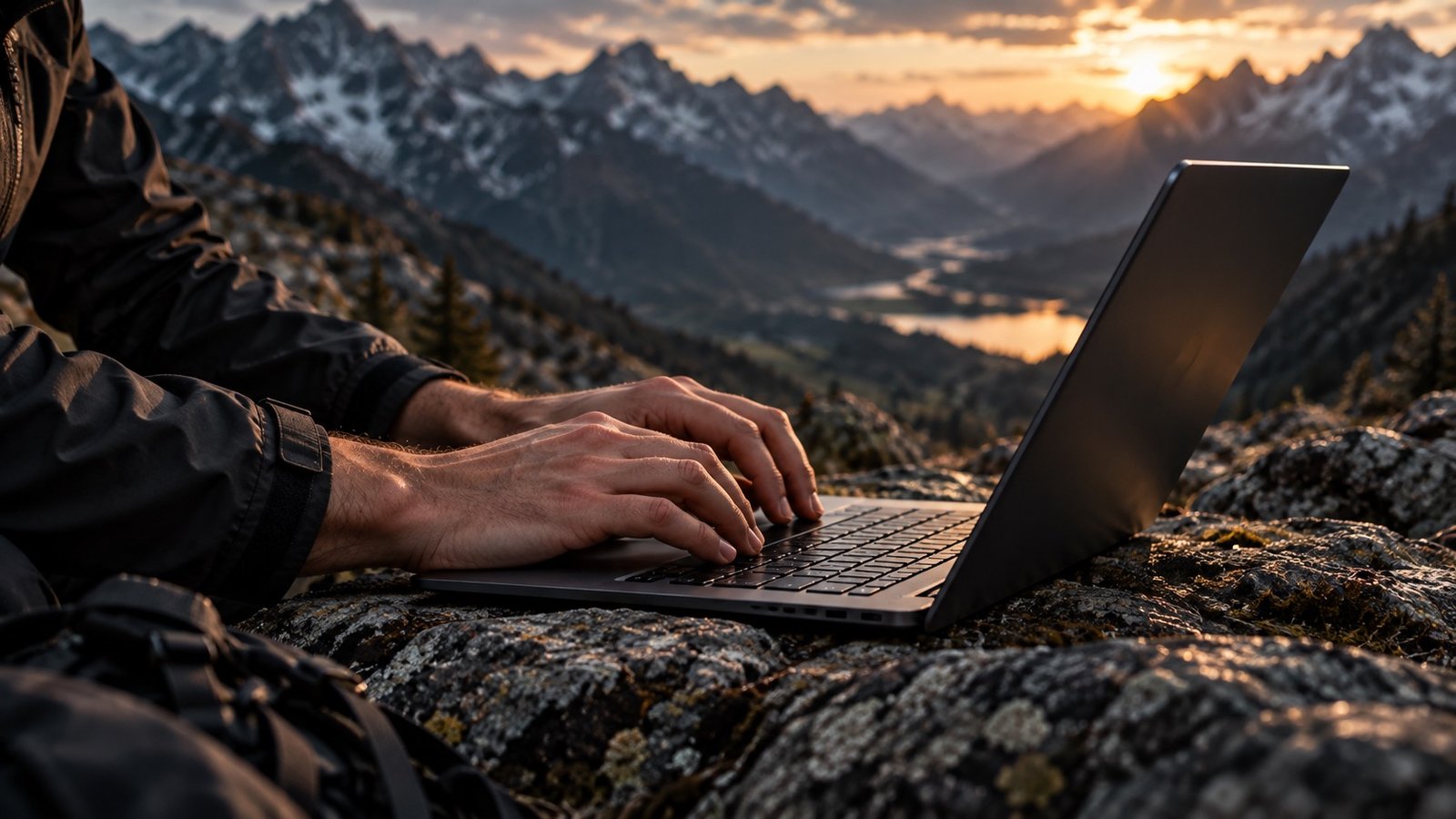
STEP 1

ENTER YOUR TRIP

Add your current altitude, target altitude, nights available and other details.
STEP 2

BUILD THE ASCENT

Our tool generates a personalised night by night plan using proven guidelines.
STEP 3

REVIEW YOUR PLAN

See your full itinerary, key insights and safety guidance — then get ready to go higher.

PLAN SMARTER

How quickly should you increase sleeping altitude?

A gradual ascent gives your body time to adapt to lower oxygen levels, reducing the risk of altitude illness and helping you perform better.

✓ Spend time at 2500 – 2700m to start acclimatizing.

✓ Above 3000m, increase sleeping altitude by 300 – 500m per night.

✓ Take a rest day every 3 – 4 days, or roughly every 1000m of gain.

✓ Adjust based on how you feel — go slower if needed.

These guidelines are based on recommendations from the UIAA, CDC and Wilderness Medicine Society (WMS).

THE BIGGER PICTURE

Why Sleeping Altitude Matters More Than Your Highest Point

Your body adapts during rest, not at the top. It’s your sleeping altitude — the altitude you spend the night at — that drives acclimatization, not your highest point of the day.

SLEEPING ALTITUDE

Drives real physiological adaptation. The longer you sleep at a given altitude, the more your body adjusts to the lower oxygen levels.

DAYTIME HIGH POINT

Effects you in the short term, but doesn’t provide the same acclimatization stimulus. Short daytime excursions above your sleeping altitude are generally well tolerated.

KEY CONSIDERATIONS

What Affects How Quickly You Acclimatize?

Everyone responds differently to altitude. These key factors influence how quickly you adapt.

ASCENT RATE

Faster ascents give your body less time to adapt, increasing the risk of altitude illness.

PREVIOUS ALTITUDE EXPOSURE

Recent time at altitude can improve your response, but the effects fade over time (usually days to weeks).

INDIVIDUAL RESPONSE

Age, genetics, fitness and previous altitude experience all affect how quickly you acclimatize.

SLEEP ALTITUDE

The higher you sleep the stronger the acclimatization stimulus — and the greater the physiological demands.

HYDRATION, FUELING & RECOVERY

Good hydration, adequate nutrition and quality rest support adaptation and overall performance.

ROUTE, TERRAIN & WEATHER

More demanding routes, extreme cold, wind and additional stressors can make acclimatization more challenging.

BUILD ON PAST EXPERIENCE

Recent Altitude Exposure & Pre-Acclimatization

If you’ve been at altitude in the days or weeks before your trip, your body may already be partly acclimatized, which can help you adapt more quickly. However, the benefits are temporary and typically fade within days to weeks, so they shouldn’t replace a gradual ascent plan.

HOW LONG THE BENEFITS LAST

Days to weeks

Most of the benefits typically last from a few days to a few weeks.

Not permanent

Acclimatization decreases when you return to low altitude and is not maintained long term.

Still follow guidelines

Previous exposure can help, but you should still follow standard altitude acclimatization guidelines for your new trip.

YOUR SAFETY COMES FIRST

Recognising When You Should Stop Ascending

Altitude illness can affect anyone. Knowing the signs and responding early helps keep you safe and ensures you can continue your journey another day.

KEY SAFETY GUIDELINES

Do not ascend with symptoms

If you have symptoms of altitude sickness, do not go higher.

Rest if symptoms occur

Stop ascending, rest, hydrate and monitor your symptoms.

Descend if symptoms worsen

If symptoms persist or get worse, descend to a lower altitude. This is the safest and most effective treatment.

Who Is The Planner For?

Our altitude acclimatization planner helps anyone heading to higher places perform better, stay safer and get more from their time in the mountains
Hikers & Trekkers

From multi-day treks to bucket list adventures, plan smarter and enjoy the journey with greater confidence.

mountaineers

Prepare for technical climbs and high altitude expeditions with evidence-based acclimatisation strategies.

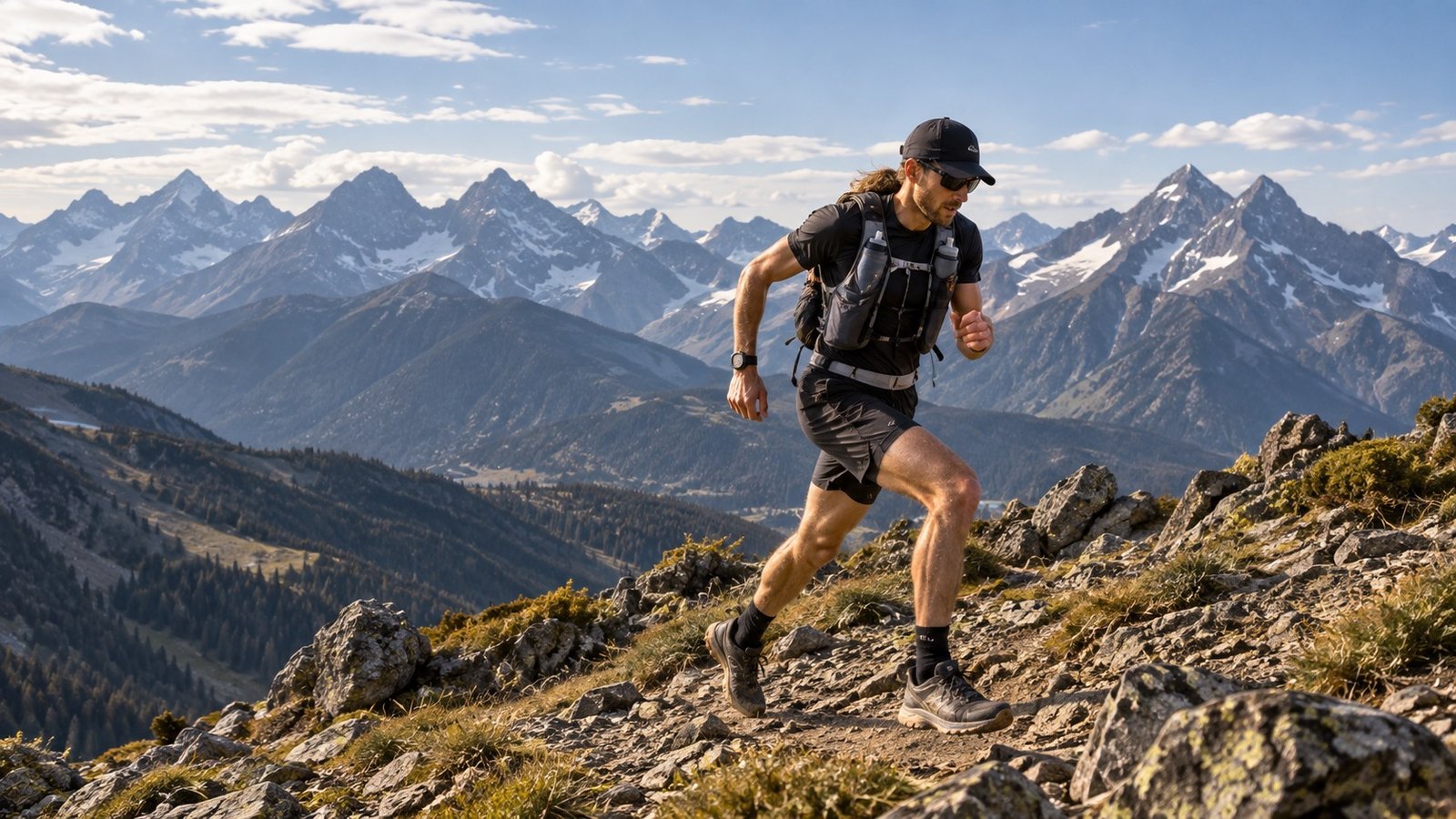
Trail & Ultra Runners

Maximise performance and minimise risk at altitude races and high mountain events.

Mountain Athletes/ Expeditions

For guides, athletes and expedition teams operating in remote and extreme environments.

Example Acclimatization Plan

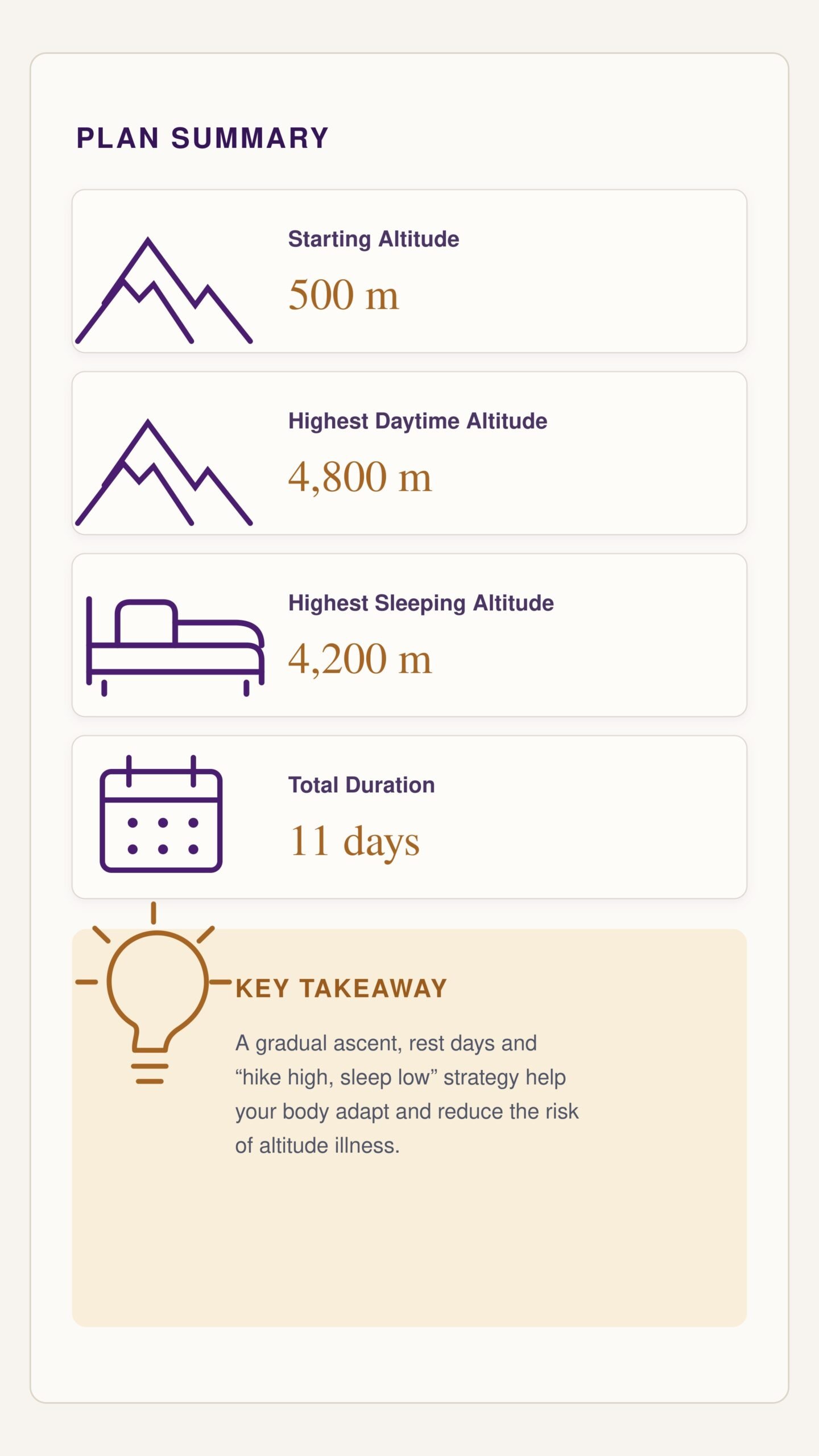
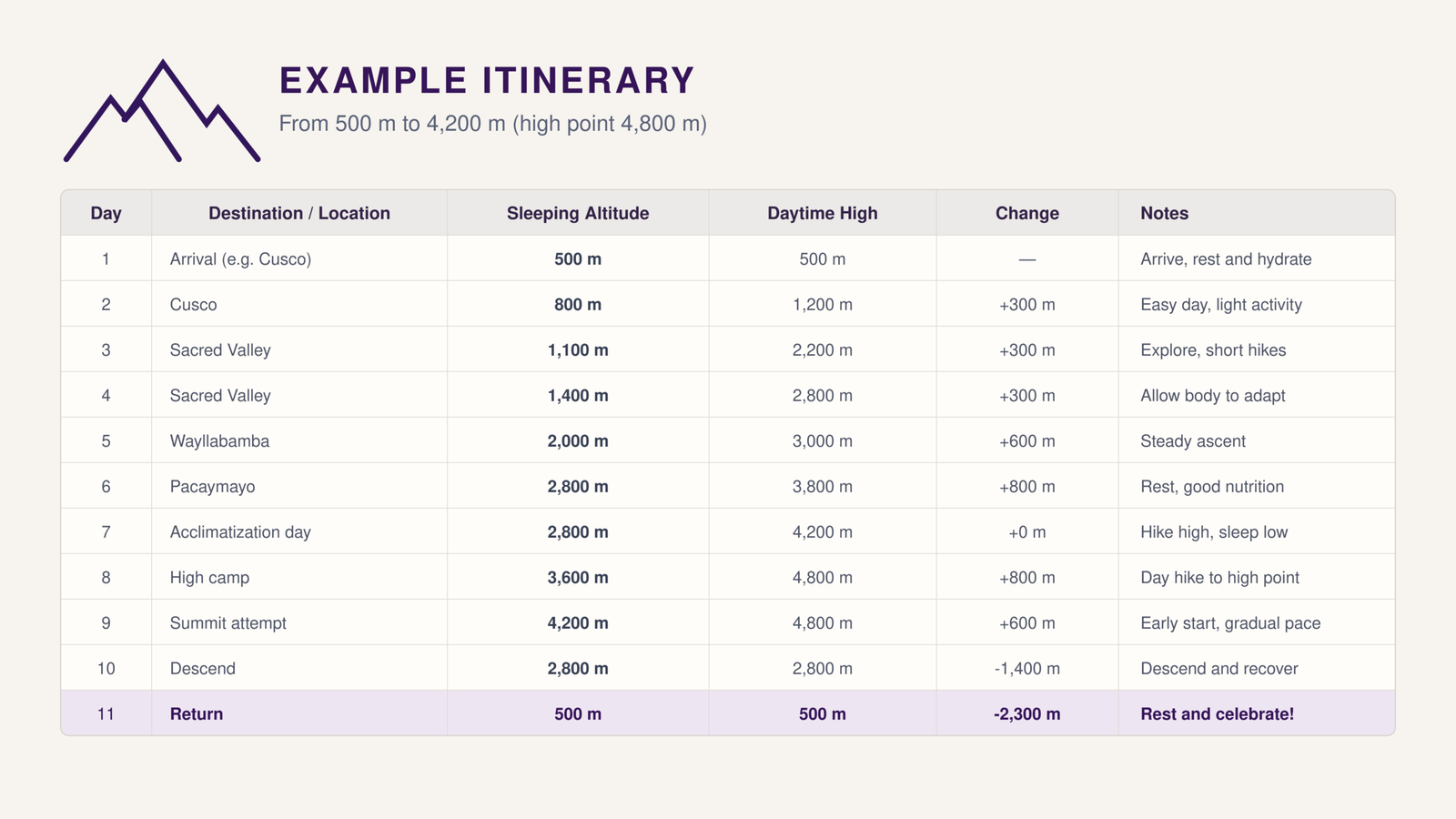
A real world example to show how the planner works. This itinerary takes you from 500m to a sleeping altitude of 4,200m, with a daytime high point of 4,800m, following safe acclimatization guidelines.

HIGHER PLACES

A BRIGHTER YOU

FREQUENTLY ASKED QUESTIONS

Can I customise the plan for my specific trip?2026-09-19T20:26:09+01:00

Yes. You can adjust your starting altitude, target sleeping altitude, highest daytime point, available nights, preferred progression rate and recent altitude exposure. Recalculate the plan whenever your itinerary changes.

What altitude gain per day is considered safe?2026-09-19T20:25:30+01:00

Once above 3,000 metres, sleeping altitude should generally increase by no more than 300–500 metres per night. An additional acclimatization day should be considered every three to four days, or after approximately 1,000 metres of sleeping-altitude gain.

How does the altitude acclimatization planner work?2026-09-19T20:24:52+01:00

Enter your current sleeping altitude, target altitude, highest daytime altitude, available nights and recent altitude exposure. The planner then creates a personalised night-by-night ascent schedule, including suggested acclimatization or rest days.

Is this a substitute for medical advice?2026-09-19T20:28:17+01:00

No. The planner provides general educational guidance and cannot assess your individual health, symptoms or medical history. Consult a qualified medical professional before high-altitude travel if you have a medical condition, previous severe altitude illness or concerns about your planned ascent.

What if I start to feel symptoms of altitude illness?2026-09-19T20:27:32+01:00

Do not ascend to a higher sleeping altitude while experiencing symptoms. Rest at your current altitude and monitor how you feel. If symptoms worsen, or you develop confusion, poor coordination or breathlessness at rest, descend and seek urgent medical assistance.

Does the planner take into account my fitness level?2026-09-19T20:26:49+01:00

The planner focuses primarily on sleeping altitude, ascent rate and recent altitude exposure. Physical fitness can improve your ability to manage the activity itself, but it does not reliably protect you from altitude illness or justify ascending more quickly.

Evidence & Guidance

Our altitude acclimatization planner is built on established medical and mountaineering guidelines from leading organisations.

CDC Yellow Book

Guidance on high altitude travel and altitude illness prevention (Centre for Disease Control & Prevention).

Wilderness Medical Society

Clinical practice guidelines for the prevention and treatment of altitude illness.

UIAA International Climbing & Mountaineering Federation

Recommendations for safe high altitude mountaineering and expedition travel.

PLAN HIGHER. GO FURTHER.

Preparing for a high altitude trek or climb?

Get expert guidance and a personalised plan to help you acclimatize safely, perform better and make the most of your mountain adventure.

Go to Top