
cardio calculator2026-07-16T21:27:00+01:00

CARDIO ZONE CALCULATOR

Cardio Training Zones.

Train Smarter. Improve Endurance. 

Calculate your personalised heart rate training zones using the Karvonen Formula (HRR). Optimise every session, track progress, and perform at your best.

Trusted formula used by endurance athletes and coaches worldwide.

1. Enter Your Details

years
bpm
bpm

Your data is secure and never stored.

Karvonen Formula

Target HR = ((HRmax − HRrest) × intensity) + HRrest

2. Your Cardio Training Zones

Resting HR 60 bpm
Max HR 185 bpm
Heart Rate Reserve 125 bpm
Zone Intensity % HRR Heart Rate Range
Zone 1 Recovery 50–60% 123–135 bpm
Zone 2 Aerobic Base 60–70% 135–148 bpm
Zone 3 Tempo 70–80% 148–160 bpm
Zone 4 Threshold 80–90% 160–173 bpm
Zone 5 VO₂ Max / Peak 90–100% 173–185 bpm
Heart Rate Zones Visualization
129
Zone 1
142
Zone 2
154
Zone 3
167
Zone 4
179
Zone 5

Zones are calculated using the Karvonen Heart Rate Reserve method. Use them to guide recovery, endurance, tempo, threshold and high-intensity cardio sessions.

HOW THE KARVONEN FORMULA WORKS

1. RESTING HR

Your resting heart rate

is the number of times

your heart beats per

minute.

MAX HR

Your maximum heart rate

is the highest number of

beat per minute your

heart can reach.

HEART RATE RESERVE

HRR= Max HR- Resting HR

this is your hearts effective

training range.

TARGET INTENSITY

Each training zone is a

percentage of your HRR,

plus your resting HR.

WHY USE CARDIO TRAINING ZONES?

TRAIN SMARTER

Train in the right zone to

maximise results and

avoid overtraining.

BUILD ENDURANCE

Improve aerobic capacity

and stamina with consistent

zone based training.

TRACK PROGRESS

Monitor improvement

in fitness, efficiency,

and recovery.

OPTIMISE RECOVERY

Stay in the right zone for

efficient recovery and

reduced fatigue.

PERFORM BETTER

Enhance performance

in races, events and

daily training.

FREQUENTLY ASKED QUESTIONS

Why is Zone 2 training so important?2026-07-07T14:20:26+01:00

Zone 2 training helps build your aerobic base, which is essential for endurance, recovery, and long-term cardiovascular fitness.

Training in Zone 2 improves your ability to use oxygen efficiently, supports fat oxidation, enhances mitochondrial function, and allows you to accumulate more training volume without excessive fatigue.

It is especially useful for runners, cyclists, hikers, mountain athletes, and anyone who wants to improve stamina without overtraining.

How often should I recalculate my zones?2026-07-07T14:19:24+01:00

You should recalculate your zones every 4–8 weeks, or whenever your resting heart rate changes noticeably.

As your fitness improves, your resting heart rate may decrease, which can slightly change your training zones. You should also update your zones after a long training break, illness, major weight change, or a new max heart rate test.

For best accuracy, use a consistent resting heart rate measurement taken first thing in the morning.

What is the Karvonen Formula?2026-07-07T14:18:31+01:00

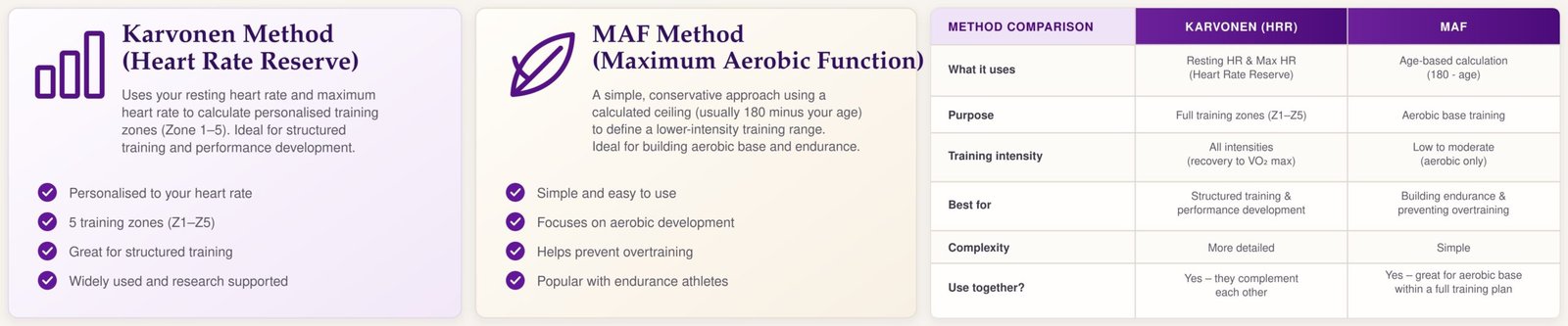
The Karvonen Formula is a heart-rate training method that uses both your maximum heart rate and your resting heart rate to calculate more personalized cardio zones.

Instead of only using a percentage of your max heart rate, it calculates your heart rate reserve, which is the difference between your max heart rate and resting heart rate.

Formula:
Target HR = ((Max HR − Resting HR) × Intensity) + Resting HR

This makes the zones more individualized and useful for endurance training, fat loss, aerobic conditioning, and performance tracking.

Do I need to warm up before training?2026-07-07T14:22:26+01:00

Yes. You should warm up before every cardio session, especially before intervals, threshold work, or high-intensity training.

A good warm-up gradually increases your heart rate, improves blood flow to working muscles, prepares your joints, and reduces the risk of starting too hard too soon.

For most sessions, start with 5–15 minutes of easy movement before progressing into your target training zone.

Can I use a fitness watch for this?2026-07-07T14:21:51+01:00

Yes. A fitness watch can be useful for tracking your heart rate zones during training, especially for steady-state cardio.

However, wrist-based heart rate sensors can sometimes be less accurate during high-intensity intervals, rapid pace changes, cold weather, or activities with lots of arm movement.

For better accuracy, especially during structured training, a chest strap heart rate monitor is usually more reliable.

Is max heart rate the same for everyone?2026-07-07T14:21:09+01:00

No. Maximum heart rate varies between individuals and is influenced by age, genetics, training background, and physiology.

Age-based formulas can provide a useful estimate, but they are not perfect. Two people of the same age can have very different true maximum heart rates.

For the most accurate result, use a professionally supervised max heart rate test or a reliable field test if you are experienced and medically cleared for intense exercise.

Want a Training Plan Built Around You?

Our coaches create personalised training and nutrition plans to help you reach your endurance and performance goals.

Go to Top